


Strategy & Frameworks
What Is Value Chain Analysis and How Do You Use It?
Value Chain Analysis is a strategic assessment framework used to examine the discrete operational activities an organisation performs to design, produce, market, deliver, and support its product or service. Research from the Harvard Business School Institute for Strategy and Competitiveness defines the value chain as breaking a company down into strategically relevant activities, which serve as the basic units of competitive advantage. Similarly, guidance from Harvard Business School Online explains that Value Chain Analysis evaluates each stage of creation and delivery to identify where operational improvements and customer benefits may exist. Rather than viewing a company as an undivided enterprise, this method disaggregates internal operations into distinct functions. Consequently, business owners can better understand where customer value appears to be created, where costs accumulate, and how individual functions interact to support a stronger market position.
Michael Porter formalised the value-chain framework in his 1985 work on competitive advantage. The framework developed from the idea that competitive advantage cannot be understood by examining an organisation only as a whole. Instead, advantage can emerge from the specific activities a firm performs in designing, manufacturing, marketing, delivering, and supporting its offerings. As outlined by Monash Business School, the value chain links activities from initial sourcing through to final delivery. Within this framework, value refers to the benefit created for customers and the economic value the business is able to capture from that benefit. Educational material from The Open University connects commercial value creation with transforming operational inputs into outputs that are more useful, desirable, or efficient for the buyer, with profitability depending on the relationship between the value created and the costs of performing those activities.
To analyse an organisation systematically, Porter divides business activities into primary activities and support activities. According to research published by The Open University, primary activities directly involve the creation, sale, transfer, and post-sale support of an offering. Inbound logistics encompasses receiving, storing, and scheduling raw inputs. Operations converts those inputs into final outputs through manufacturing, assembly, or service execution. Outbound logistics manages warehousing, order fulfilment, and delivery to buyers. Marketing and sales generates customer awareness, communicates benefits, selects distribution channels, establishes pricing, and secures transactions. Finally, service includes post-sale activities such as installation, onboarding, training, and customer support, which help protect or enhance the value delivered to the buyer.
While primary activities form the sequential flow of creation and delivery, support activities provide the foundational infrastructure required for primary functions to operate effectively. Procurement involves purchasing inputs, software, equipment, and services across the organisation. Technology development encompasses product design, software engineering, process automation, and data infrastructure. Human resource management oversees recruitment, training, retention, and compensation systems. Lastly, firm infrastructure includes leadership, legal affairs, financial management, planning, and quality assurance. Although support activities often operate behind the scenes, their alignment with primary functions can significantly influence operational efficiency and performance. For example, effective procurement may improve input quality, supplier reliability, or cost depending on the supplier strategy, which can in turn influence operational quality and margins.
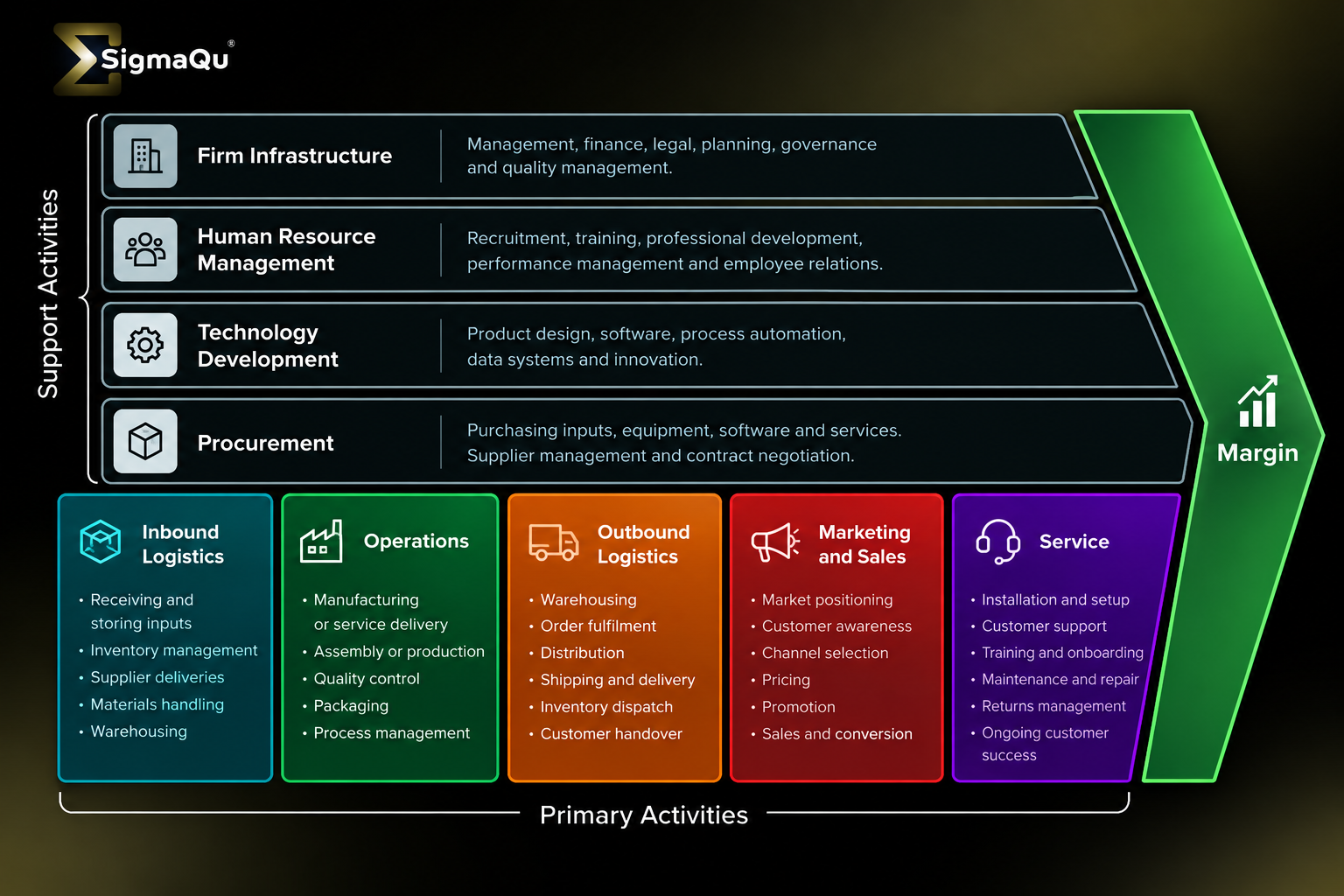
This visual layout shows how support activities sit above the primary activity flow, with margin created when the full system works together efficiently.
Furthermore, a central strength of Value Chain Analysis lies in understanding that activities do not exist in isolation. Value creation depends on linkages between internal functions. Analysis from the Harvard Business School Institute for Strategy and Competitiveness emphasises that competitive advantage can stem from how activities are configured and connected rather than from the efficiency of a single department. For instance, investing in advanced technology development can automate inventory tracking, streamlining outbound logistics and reducing customer support inquiries. Similarly, aligning a comprehensive product development plan with a clear product development strategy helps ensure that initial product design reflects customer needs, manufacturing capabilities, and sales positioning, thereby reducing the risk of costly redesigns later in the cycle.
Understanding these internal connections requires evaluating two critical forces: value drivers and cost drivers. A value driver is any activity or characteristic that can increase customer willingness to pay, such as product reliability, rapid delivery, superior service, or innovative features. Conversely, a cost driver is a structural factor that influences the cost of an activity, including labour efficiency, material expenses, economies of scale, and process complexity. Research on strategic positioning from the Harvard Business School Institute for Strategy and Competitiveness explains that competitive advantage generally depends on achieving a favourable relative cost or relative price position. Consequently, a company may pursue cost advantage by configuring its activities to achieve a structurally lower relative cost position without undermining the value customers care about, or pursue differentiation by performing distinctive activities that support a higher relative price, as reflected in Harvard's work on the distinctive value chain.
Carrying out a Value Chain Analysis in practice involves a structured evaluation of operational reality. The process begins by defining the specific product, service line, or business unit to be analysed. Next, management maps the primary and support activities required to bring that offering to market. Following activity mapping, the team quantifies costs associated with each step where possible and assesses how each activity contributes to customer value. In guidance published by HMRC, value chain analysis is discussed in a transfer-pricing context and involves examining functions, assets, risks, and key value drivers to understand which activities contribute most significantly to economic outcomes. Although HMRC's full methodology is designed for multinational and tax-related analysis rather than small-business strategy, the underlying concepts of evidence-based activity mapping and identifying value drivers remain useful. After evaluating cost and value drivers, leadership can analyse internal linkages to identify bottlenecks, duplication, or misaligned priorities. Business owners seeking a structured digital platform to guide this evaluation can utilise the dedicated SigmaQu Value Chain tool to map activities, evaluate drivers, and identify strategic improvement opportunities.
To see how this framework functions in practice, consider a fictional independent specialty coffee roaster operating an e-commerce subscription model alongside wholesale accounts. Inbound logistics involves sourcing ethically farmed green coffee beans and managing warehouse storage. Operations focuses on roasting, batch quality testing, and protective packaging. Outbound logistics manages automated order fulfilment and courier shipping. Marketing and sales drives subscription sign-ups through digital content and wholesale relationships, while service provides customer support and subscription management. Support activities include procuring specialised roasting machinery, training staff on cupping standards, and managing financial planning. By conducting a value chain review, the owner discovers that while roasting is highly efficient, manual packaging creates an outbound logistics bottleneck that delays shipping and increases labour costs. Investing in automated packaging technology could lower outbound cost drivers while helping improve delivery speed and product freshness, illustrating how operational changes described in Value Chain Optimization for Supply Chain and Logistics can influence overall performance.
Moreover, service-based and digital businesses can adapt this framework effectively. For a management consultancy or software firm, traditional labels such as inbound and outbound logistics need to be interpreted conceptually rather than literally. Inbound activities might include client briefs, market data, user feedback, or technical requirements. Operations may consist of research, advisory work, software engineering, or system testing. Outbound activities could involve report delivery, implementation, software deployment, or customer handover. Marketing and sales focuses on relationship building, proposals, content leadership, and conversion, while service involves ongoing client management, technical support, and user onboarding. The essential principle remains unchanged: whether delivering physical goods or professional expertise, value is created through a connected network of deliberate activities.
To apply Value Chain Analysis effectively, business leaders must distinguish it from related strategic management tools. Supply-chain analysis generally concentrates on the end-to-end flow of goods, services, information, resources, inventory, and logistics across suppliers, internal operations, distributors, and customers. Value Chain Analysis is broader in strategic purpose because it examines how a firm's activities contribute to customer value, cost position, and competitive advantage, including areas such as technology, marketing, service, procurement, and human resources. In a similar way, while gap analysis measures the difference between current performance and target goals, Value Chain Analysis can help investigate which activities may be contributing to that performance variance. Furthermore, while external market frameworks like SigmaQu Porter's Five Forces evaluate broader industry competitive pressures such as buyer leverage and rivalry, Value Chain Analysis looks inward at the configuration of internal activities that may help the business respond to those pressures effectively.
Once activity strengths and cost drivers are identified, leadership can translate these insights into broader corporate planning by embedding findings into a SigmaQu Strategic Plan or mapping connected operational goals across departments using a SigmaQu Strategy Map. Harvard's work on productivity in the value chain discusses areas such as procurement, logistics, resource efficiency, supplier capability, and workforce conditions as factors that can influence productivity and long-term value creation. The framework has limitations, such as the potential to oversimplify complex, non-linear business ecosystems, but material from The Open University shows how mapping value activities can help managers understand where customer benefit and profitability may arise. Ultimately, sustainable competitive advantage is not achieved through a single department or aggressive cost reduction alone. It can be strengthened when an organisation configures its activities so that they reinforce one another, support customer value, and contribute to a favourable cost or differentiation position.